1996 Toyota Previa S/C 0-60 Times, Top Speed, Specs, Quarter Mile, and Wallpapers
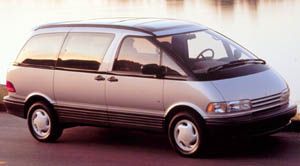
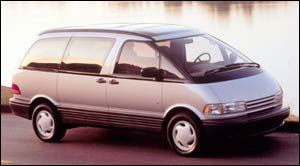
The 1996 Toyota Previa S/C is a Front-wheel drive MiniVan. It can accommodate up to 7 passengers. It has 3 Doors and is powered by a 2.4L L4 DOHC 16 valves Supercharged engine which outputs 161 hp @ 5000 rpm and is paired with 4 speed automatic gearbox. The 1996 Toyota Previa S/C has cargo capacity of 4468 Liters and the vehicle weighs kg. In terms of ride assists, the 1996 Toyota Previa S/C has stability control and traction control in addition to anti-lock brake system (ABS). The vehicle has an optional engine as well It offers and. Safety features also include None and None. The front suspension is while the rear suspension is. The car also features a It has as standard. Electronic features include Cruise Control. For convenience, the car has Power windows and Power door locks. There is also a remote keyless entry feature. Moreover, the car has. The steering wheel has audio control buttons. In terms of performance, the car has 176 N.m of torque and a top speed of 200 km/h. The 1996 Toyota Previa S/C accelerates from zero to 60 mph in 11.3 seconds and hits quarter mile at 18.3 seconds. Fuel consumption is 13.3 L/100km in the city and 10 L/100km in the highway. The car price starts at $ 35,908
| Name | S/C | |
|---|---|---|
| Price | $ 35,908 | |
| Body | MiniVan | |
| Doors | 3 Doors | |
| Engine | 2.4L L4 DOHC 16 valves Supercharged | |
| Power | 161 hp @ 5000 rpm | |
| Number of Seats | 7 Seats | |
| Transmission | 4 speed automatic | |
| Cargo Space | 4,468.0 L | |
| Maximum Cargo Space | 4,468.0 L | |
| Wheel Type | ||
| Series | Previa (CR) | |
| Drivetrain | Front-wheel drive | |
| Horsepower | 161 HP | |
| Torque | 176 N.m | |
| Top Speed | 200 km/h | |
| Acceleration 0-100 km/h (0-60 mph) | 11.3 s | |
| Fuel Type | Petrol (Gasoline) | |
| Fuel Consumption (City) | 13.3 L/100km | |
| Fuel Consumption (Highway) | 10.0 L/100km | |
| Gear Type | manual | |
| Weight | 1,850 KG | |
| Brand | Toyota | |
| Model | Previa | |
| 0-400m (Quarter Mile) | 18.3 s | |
| 0-400m (Quarter Mile) - Speed | 125.9 km/h | |
| 0-800m (Half Mile) | 30.3 s | |
| 0-800m (Half Mile) - Speed | 141.8 km/h | |
| Modifications (MODS) | ||
| Modifications Cost | $ 0 |
1996 Toyota Previa Used Price Estimates
Estimates based on a driving average of 12,000 miles per year| Used Condition | Trade In Price | Private Party Price | Dealer Retail Price |
|---|---|---|---|
| Outstanding | $ 1,859 | $ 2,814 | $ 3,278 |
| Clean | $ 1,694 | $ 2,564 | $ 3,000 |
| Average | $ 1,364 | $ 2,065 | $ 2,442 |
| Rough | $ 1,033 | $ 1,565 | $ 1,885 |
What runs supercharged power, has available all-wheel drive, met 1997 passenger car side-impact standards six years early, is as reliable as a Retriever, and boasts one of the most uniquely attractive shapes on the road? A high-profile sports car? A concept vehicle from the early '90s? Give up? It's the Toyota Previa minivan. That's right. A minivan. And in addition to all of these fine attributes, the Previa adds dual airbags, comfortable seating for seven, optional antilock brakes, and up to 152.3 cubic feet of cargo capacity.
Toyota minivans come only with a supercharged engine this year; a wise move by product planners since the old base four-cylinder engine was a wheezemeister when it came to traversing anything with an incline. Previas are sold in DX or step-up LE trim, either rear-drive or with permanent All-Trac four-wheel drive.

Acceleration with the 161-horsepower, 2.4-liter supercharged engine is strong. However, it tends to be noisy, and gas mileage isn't the greatest. Worse yet, premium fuel is recommended. A four-speed automatic is the only transmission choice. The engine is mounted amidships, below the floor, but major service points are accessible from under the front hood.
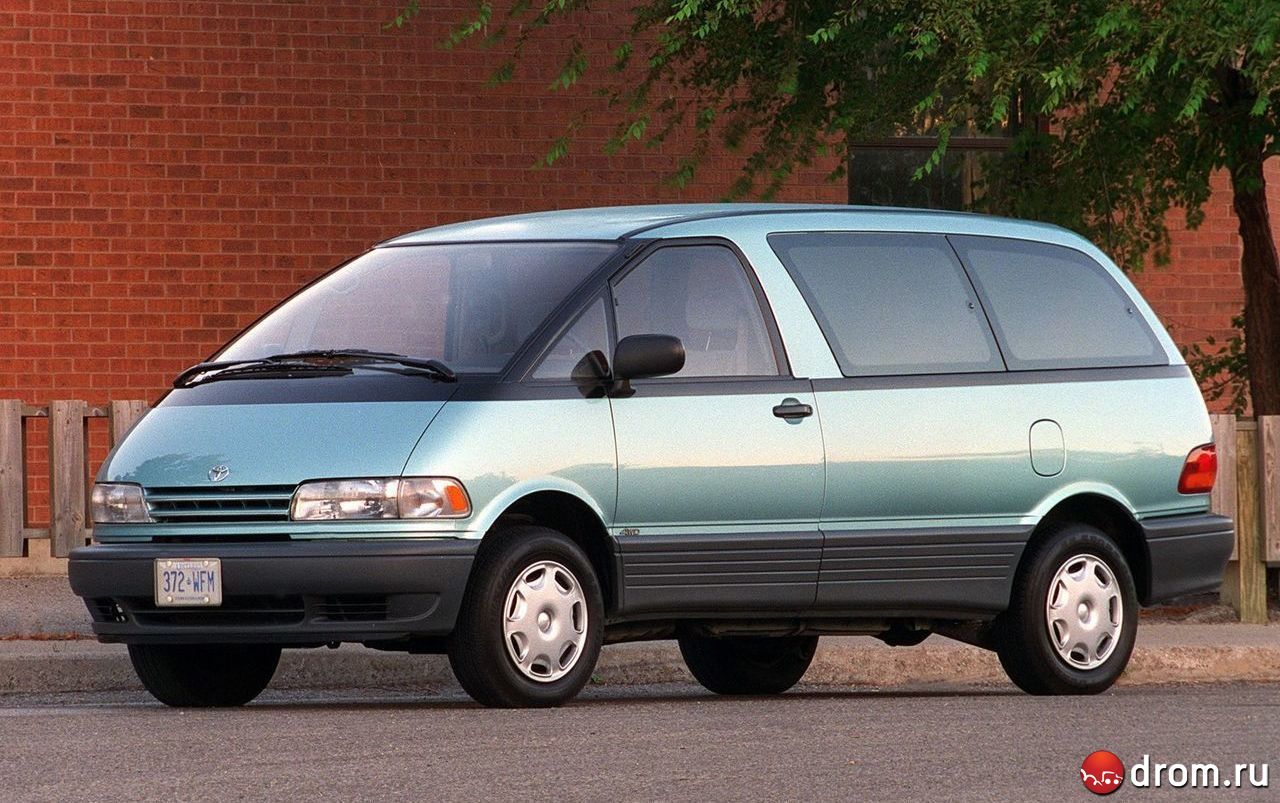
Seven people sit in reasonable comfort, with a fair amount of cargo space out back. Either or both sides of the split rear seat folds outward against the bodysides for extra cargo-hauling capacity, while the two-passenger center seat can be removed completely. Swivel-recline captain's chairs can be installed instead, and two-wheel-drive LE Previas can have dual power moonroofs--that's right, a pair of openings to the sky. Standard LE fittings include power door locks and windows, as well as dual air conditioners.
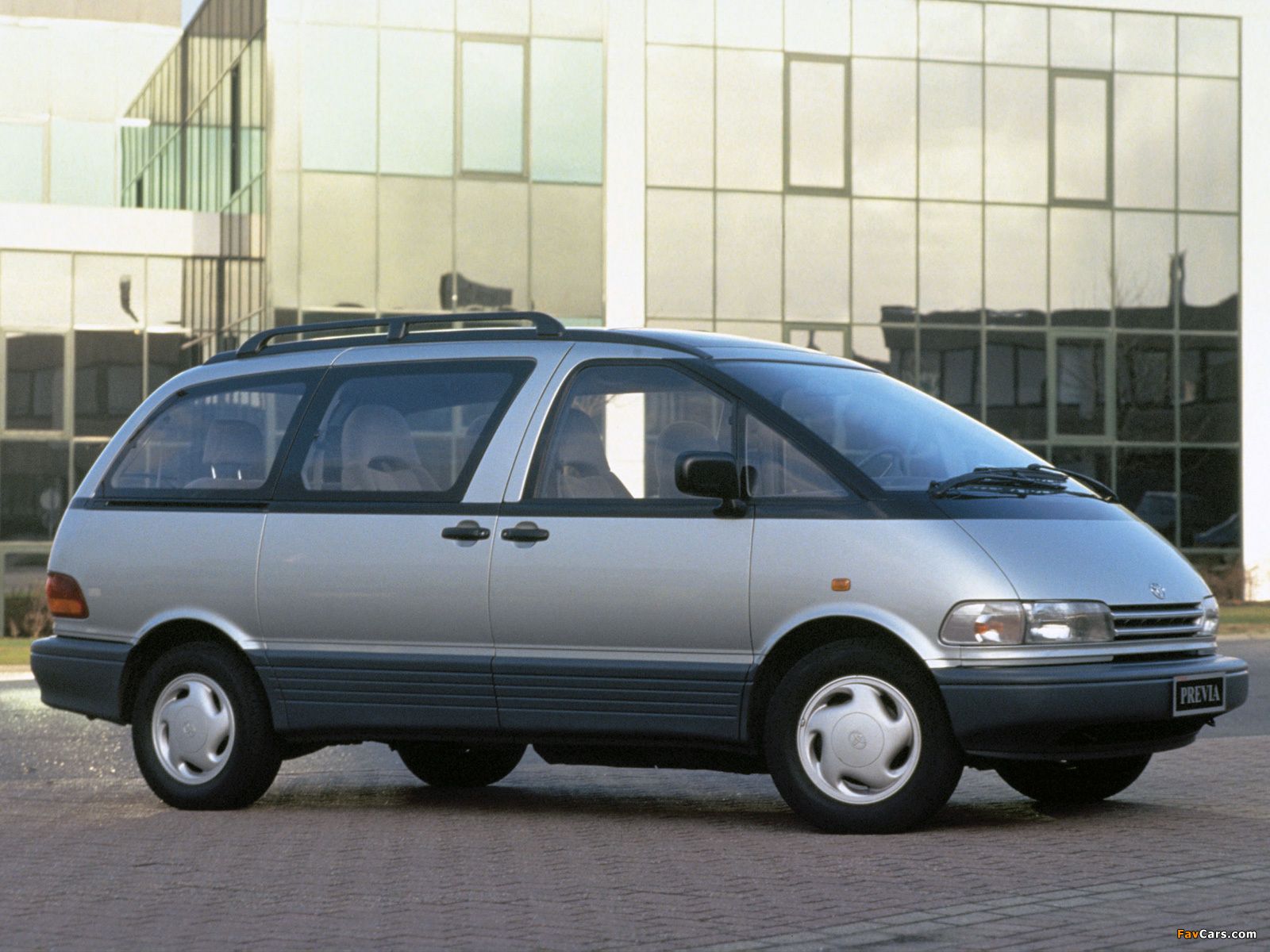
Unlike some competitors, Previas exhibit a distinctively rounded profile--one of the first minivans to go with curvaceous lines rather than a boxy shape. Previas aren't exactly cheap, and lack a V6 engine option, but like other Toyotas, they provoke relatively few complaints from owners.
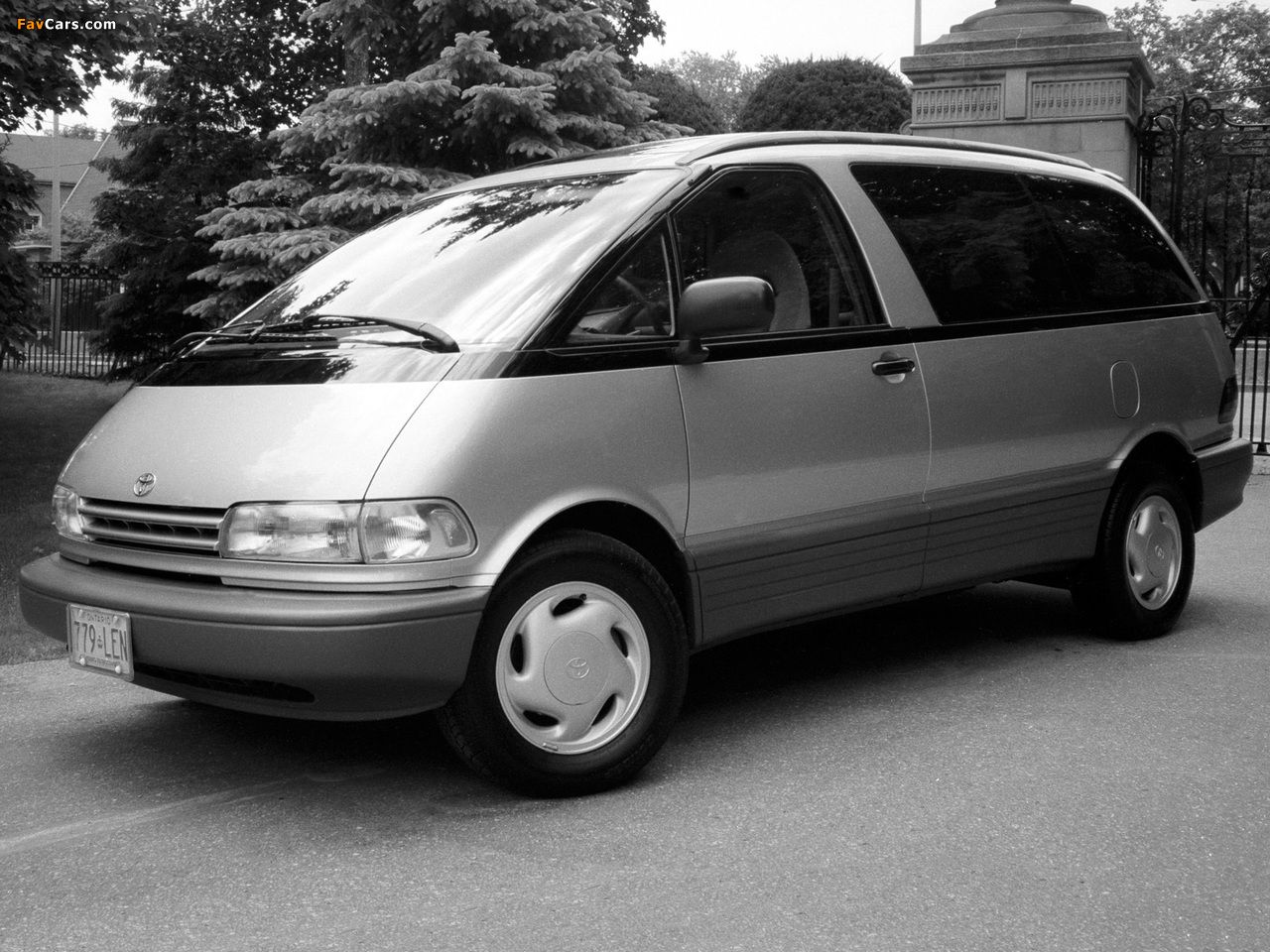
Vehicles like this make us wonder why so many people are scooping up underpowered, less capable sport utilities. We like the Previa. You might too.
1996 Toyota Previa S/C Exterior Colors
1996 Toyota Previa S/C Interior Colors
1996 Toyota Previa Engines
| Engine | Standard in Trim | Power | Torque | Fuel Consumption - City | Fuel Consumption - Highway | 0-100 km/h | Quarter Mile | Half Mile |
|---|---|---|---|---|---|---|---|---|
| 2.4L L4 DOHC 16 valves Supercharged | SC | 161 hp @ 5000 rpm | 176 N.m | 13.3 L/100km | 10.0 L/100km | 10.2 s | 17.8 s | 29.5 s |
| 2.4L L4 DOHC 16 valves Supercharged | LE SC | 161 hp @ 5000 rpm | 176 N.m | 13.3 L/100km | 10.0 L/100km | 10.4 s | 18.0 s | 29.8 s |
| 2.4L L4 DOHC 16 valves Supercharged | LE SC 4WD | 161 hp @ 5000 rpm | 176 N.m | 14.1 L/100km | 10.7 L/100km | 10.6 s | 16.2 s | 30.3 s |
| 2.4L L4 DOHC 16 valves Supercharged | LE S/C | 161 hp @ 5000 rpm | 176 N.m | 13.3 L/100km | 10.0 L/100km | 11.3 s | 18.3 s | 30.3 s |
| 2.4L L4 DOHC 16 valves Supercharged | LE S/C 4WD | 161 hp @ 5000 rpm | 176 N.m | 14.1 L/100km | 10.7 L/100km | 10.5 s | 16.2 s | 30.3 s |
1996 Toyota Previa Trims
1996 Toyota Previa Previous Generations
1996 Toyota Previa Future Generations
Toyota Previa Overview and History
The government encouraged such a bold decision mostly because making their own cars would be cheaper and they also needed vehicles for the war with China. Just a year after its foundation in 1933, the Toyota Motor Company created its first engine, the Type A, placed in the Model A1 passenger car and the G1 truck.
During WWII, Toyota was committed to making trucks for the army and only the premature ending of the conflict saved the company's factories in Aichi from a scheduled Allied bomb raid. After the war, Toyota resumed car making but found more success in building trucks and buses than with cars. Still, it didn't give up on cars for good and in 1947 it came up with the Model SA, also known as the Toyopet, a name which later was applied to other models as well.
A little more successful was the Model SF which also had a taxi version but the same 27 horsepower engine as its predecessor. A more powerful model, the RH, which had 48 HP came out shortly after. Production went up rather fast and by 1955, Toyota was turning out 8400 cars a year. That year, Toyota diversified their production, adding the Jeep-like Land Cruiser and the luxury sedan, the Crown.
With numbers growing and with several models under their belt, Toyota now had its eyes set on the international market. The first dealership outside Japan was in America in 1957 an the first plant in Brazil in 1959. An interesting strategy from Toyota ensured that all models were somehow unique to the region where they were produced (they were adapted to the respective market).
The big break for Toyota on the American market came with the 70s when rising gas prices forced local producers to make smaller cars. These were thought of as entry-level and as a consequence lacked in quality of finishings. In contrast, Toyota already had several fuel-efficient models that were also of better quality. The Corolla is the best example in this sense, soon becoming America's favorite compact car.
But as far as the luxury market went, Toyota still had trouble with selling the Crown and the Cressida. At the dawn of the 80s, the entire luxury market in America was entering a downwards slope, with all the other manufacturers finding it difficult to keep up sales, and that's when Toyota came up with Lexus, a new company that would make luxury cars.
By the beginning of the 90s, Toyota vehicles became synonymous with reliability and low-cost maintenance which made them very popular all over the world. A bid for winning over the younger audience was made with the launch of models like the MR2 and the Celica.
Presently, Toyota is at the forefront of the environmental battle, with its successful hybrid model, the Toyota Prius and now announcing a plug-in electric car that will be called Toyota Plug-in HV, which will run on standard electricity powered by a lithium-ion battery pack.
1996 Toyota Previa Consumer Reviews
Compare Against Competitors
1996 Toyota Previa S/C Specifications
S/C Dimensions
| Cargo Capacity | 4468 L |
|---|---|
| Fuel Tank Capacity | 75 L |
| Height | 1780 mm |
| Length | 4750 mm |
| Max Trailer Weight | 1587 kg |
| Wheelbase | 2865 mm |
| Width | 1800 mm |
S/C Mechanical
| Drive Train | Front-wheel drive |
|---|---|
| Engine Name | 2.4L L4 DOHC 16 valves Supercharged |
| Transmission | 4 speed automatic |
S/C Overview
| Body | MiniVan |
|---|---|
| Doors | 3 |
| Engine | 2.4L L4 DOHC 16 valves Supercharged |
| Fuel Consumption | 13.3 (Automatic City)10.0 (Automatic Highway) |
| Power | 161 hp @ 5000 rpm |
| Seats | 7 |
| Transmission | 4 speed automatic |
| Warranties | Bumper-to-Bumper60000/km, 36/Months Powertrain100000/km, 60/Months Roadside Assistance60000/km, 36/Months Rust-throughUnlimited/km, 60/Months |
S/C Safety
| Anti-Lock Brakes | Std |
|---|---|
| Brake Type | Front disc/rear drum |
| Child-proof Locks | None |
| Driver Airbag | None |
| Passenger Airbag | None |
S/C Suspension and Steering
| Front Tires | P215/65R15 |
|---|
Discussion and Comments
Share Your Comments