1990 Audi V8 Quattro 0-60 Times, Top Speed, Specs, Quarter Mile, and Wallpapers

The 1990 Audi V8 Quattro is a Sedan. It has 4 Doors and is powered by a engine which outputs and is paired with gearbox. The 1990 Audi V8 Quattro has cargo capacity of Liters and the vehicle weighs kg. In terms of ride assists, the 1990 Audi V8 Quattro has stability control and traction control in addition to anti-lock brake system (ABS). The vehicle has an optional engine as well It offers and. Safety features also include and. The front suspension is while the rear suspension is. The car also features a It has as standard. Electronic features include Cruise Control. For convenience, the car has Power windows and Power door locks. There is also a remote keyless entry feature. Moreover, the car has. The steering wheel has audio control buttons. Fuel consumption is L/100km in the city and L/100km in the highway. The car price starts at $ 70,800
| Name | Quattro | |
|---|---|---|
| Price | $ 70,800 | |
| Body | Sedan | |
| Doors | 4 Doors | |
| Engine | ||
| Power | ||
| Number of Seats | N/A Seats | |
| Transmission | ||
| Cargo Space | L | |
| Maximum Cargo Space | L | |
| Wheel Type | ||
| Series | ||
| Drivetrain | ||
| Horsepower | 0 HP | |
| Torque | 0 N.m | |
| Top Speed | 0 km/h | |
| Acceleration 0-100 km/h (0-60 mph) | 0 s | |
| Fuel Type | ||
| Fuel Consumption (City) | L/100km | |
| Fuel Consumption (Highway) | L/100km | |
| Gear Type | ||
| Weight | 1,850 KG | |
| Brand | Audi | |
| Model | V8 | |
| 0-400m (Quarter Mile) | 0 s | |
| 0-400m (Quarter Mile) - Speed | 0.0 km/h | |
| 0-800m (Half Mile) | 0 s | |
| 0-800m (Half Mile) - Speed | 0.0 km/h | |
| Modifications (MODS) | ||
| Modifications Cost | $ 0 |
1990 Audi V8 Used Price Estimates
Estimates based on a driving average of 12,000 miles per year| Used Condition | Trade In Price | Private Party Price | Dealer Retail Price |
|---|---|---|---|
| Outstanding | $ 854 | $ 1,447 | $ 1,771 |
| Clean | $ 761 | $ 1,292 | $ 1,582 |
| Average | $ 574 | $ 983 | $ 1,203 |
| Rough | $ 387 | $ 673 | $ 825 |
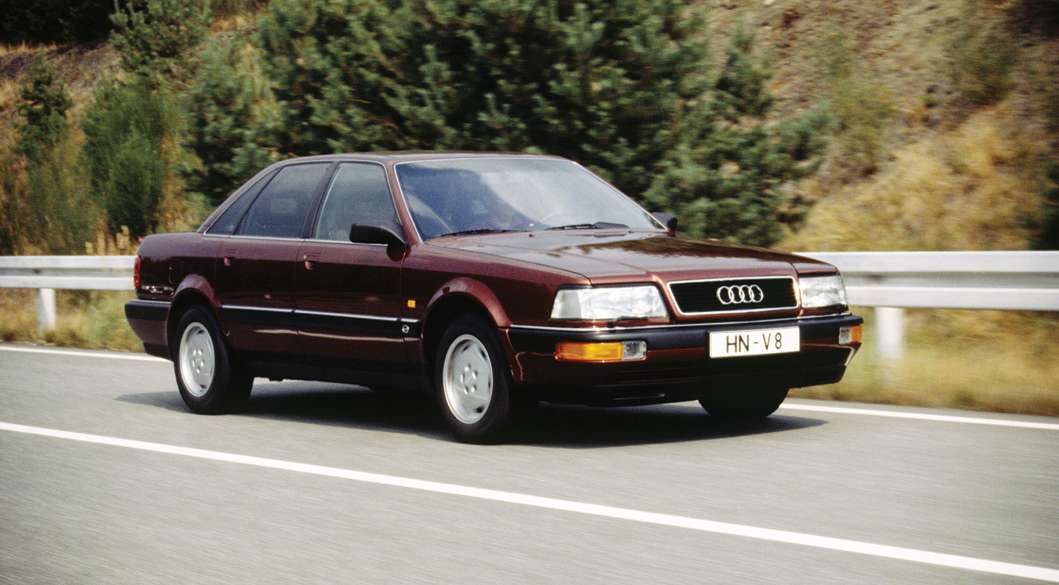
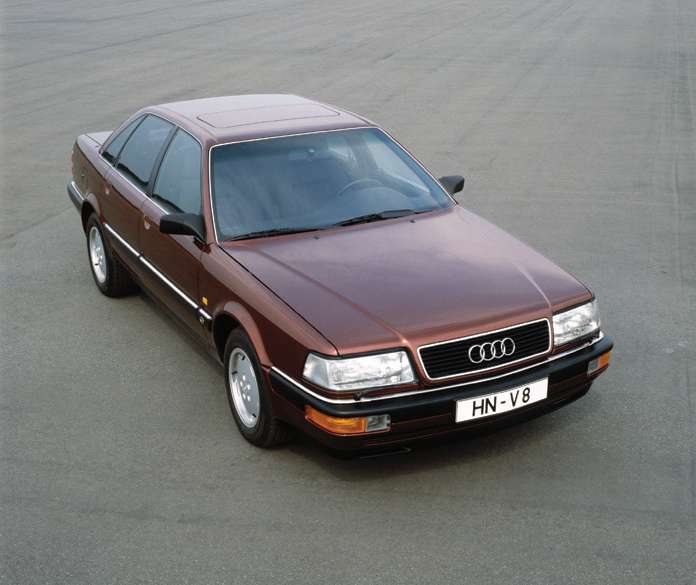
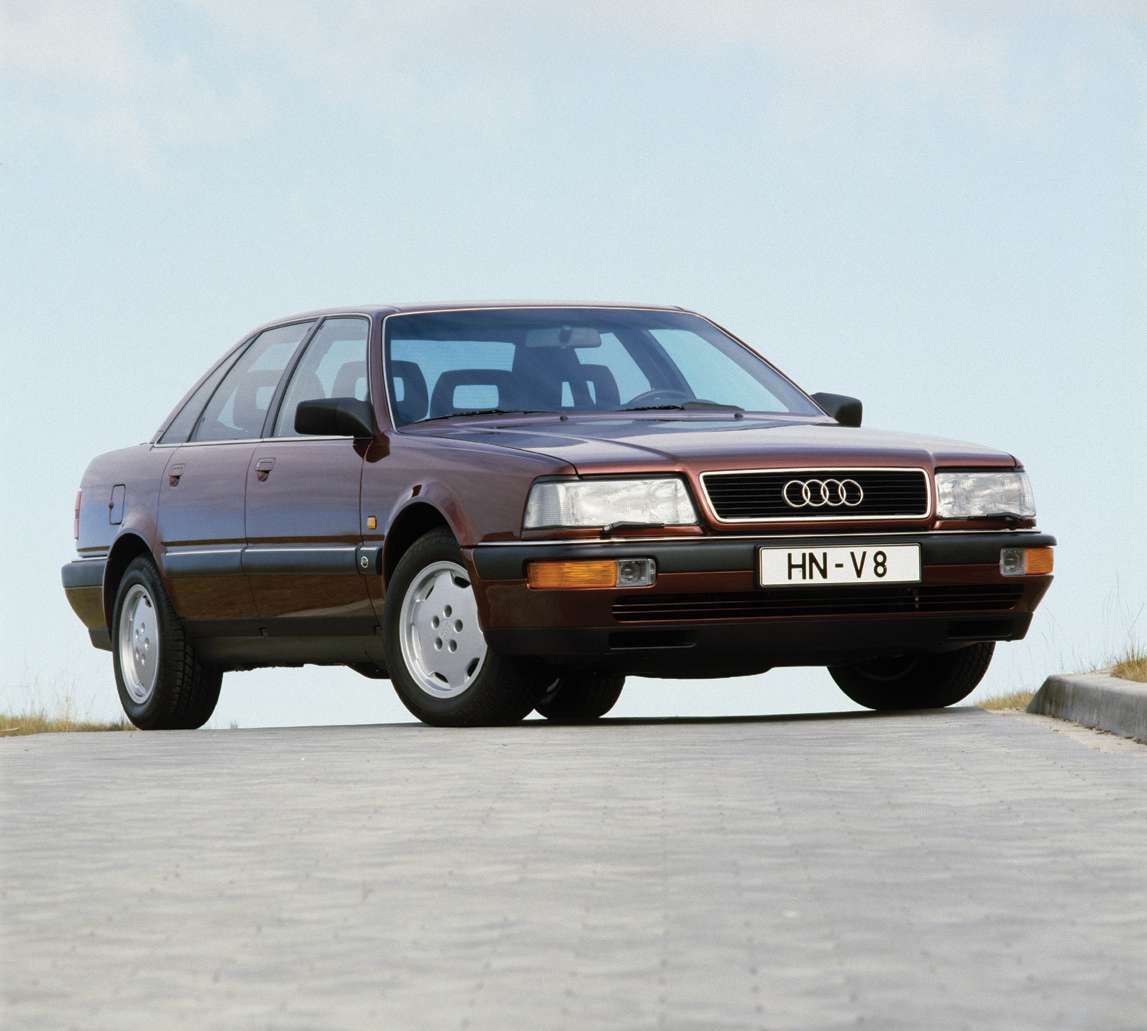
1990 Audi V8 Quattro Exterior Colors
1990 Audi V8 Quattro Interior Colors
1990 Audi V8 Engines
| Engine | Standard in Trim | Power | Torque | Fuel Consumption - City | Fuel Consumption - Highway | 0-100 km/h | Quarter Mile | Half Mile |
|---|
1990 Audi V8 Trims
1990 Audi V8 Previous Generations
1990 Audi V8 Future Generations
Audi V8 Overview and History
Automobiles undoubtedly fall into the latter category, and what better way of striking at least one of the remaining three senses if not building an image of a mighty engine roar or purr of a loyal cylinder sextet cradled under the bonnet of an Audi car? Audi translates as 'listen' from latin and besides expressing an unanimously accepted passion of the motorist, that of listening to the engine as if it were a never before heard dissertation on mechanics blended with boisterous 'deux ex machina' comments and demonstrations, it also marks the birth of Audi following Horch's demise, the previous name of the company that can be traced back to 1899.
Its founder, August Horch was forced out of his own company in 1909 due to trademark infringements, 8 years after the first automobile had rolled out the gates of the plant in Zwickau, Germany. After having been dispensed of, Horch started his own company under the same name which led to a fair share of trouble that came to an end as soon as Horch called for a meeting at the apartment of Franz Fikentscher to discuss the matter and come up with a new name for the company. Franz's son who was studying latin at the time was the true deliverer of the name that would later became synonymous with luxury and quality. As 'Horch' means listen in Old German, the boy simply made a switched the name with its latin corespondent, 'audi', sparking enthusiasm into the 'audience' that quickly adopted the name.
Audi's start o the German market was high lighted by the appearance of 2.6 liter engine powered vehicles followed by a series of more powerful ones, such as 4.7 L and the gas-gulping 5.7 L. Having gotten to see his company grow wings, Horch left in in 1920, four years before Audi's first 6 cylinder model was built. In 19128, Audi was acquired By Jorgen Rasmussen, owner of rival company DKW.
A few years later, a merger between Audi, DKW, Horch and Wanderer occurred and thus, the Auto Union was formed in 1932. Those times called for a new badge and the four interlocked rings were born as a sign of unity and identity of the newly formed auto-conglomerate. Technological improvement became a top priority that first took shape during the Second World War when an armored car was produced for the German Army.
However, all the progress would soon be severely slowed down and even halted at times due to heavy bombings. Moreover, as as soon as the conflict had come to an end, Zwickau had been caught in the soviet occupation zone that would become The German Democratic Republic in 1949. Not only that the company's activity was in jeopardy but the Auto Union had also broken up and the Union had to be restarted n new grounds, in Ingolstadt, Bavaria.
Though sluggish at first, the newly Ingolstadt based factory would attract many of the former workers and the construction of two-stroke engines would be resumed in a way similar to that of Zwickau. By 1958, Daimler-Benz had already acquired a whopping 87% of the Auto Union but its investment quickly became property of Volkswagen, the company having bought the factory and and the brands in 1964.
Soon after the change of ownership, two-stroke engines would be eliminated in favor of the more popular and more customer appealing four-stroke ones. DKW, the leading brand of the Union at the time failed as a brand despite of the changes it had made and Volkswagen decided to resurrect Audi. The former DKW built model was rebranded as an Audi one and was the springboard for the make of later models such as the 60, 75 and 80.
After a second merger with the Stuttgart based car-producer NSU by 1970, Audi established itself as a reliable growing brand that would later break the German boundaries and expand to new markets, including the North American one where it encountered difficulties following the release of a biased report that portrayed the car as suffering form 'unintended acceleration'. This was caused by the close placement of the brake and acceleration pedals, right next to each other. Shortly after the report was released , an abrupt decline in sales was registered that was countered only years later with the 1996 release of the A4 model.
Joining a row of successful car-producers, Audi has also garnered acclaim on the racing track with several World Record holdings, including one for Top Speed Endurance. Audi is currently enjoying a privileged position and large market share and is predicted to reach the production threshold of 1 million units by the end of this year.
1990 Audi V8 Consumer Reviews
1990 Audi V8 Quattro Specifications
Quattro Overview
| Body | Sedan |
|---|---|
| Doors | 4 |
| Fuel Consumption | |
| Seats | N/A |
Discussion and Comments
Share Your Comments